Hey guys, let’s cut to the chase—when you’re stocking shelves with cardboard countertop displays, the last thing you want is one that collapses before a single customer even glances at it. As someone who’s been supplying these displays for a minute, I get the pushback: “Cardboard? That’s flimsy, right?” But here’s the tea: impact resistance isn’t just about “how much weight it can hold”—it’s about how it survives the chaos of backrooms, handoffs, and accidental bumps, and that’s what makes or breaks a display’s job. Cardboard Countertop Display

First, let’s set the scene because you live this too. I’ve seen a truck back into a stack of displays at a loading dock, only one or two got banged up—most were good. I’ve watched a stocker knock a full case of energy drinks into a display of snack bars, and the display stood tall. And yeah, I’ve seen the ones that fold like a lawn chair when a new hire drags them across the floor too. So it’s not that cardboard is weak—it’s that most suppliers don’t nail the impact-resistant tweaks that make a display actually work.
Let’s break down what impact resistance even means here, because it’s not a textbook term. For your average countertop display, impact comes in three forms, not just one: abrupt, blunt force (like a dropped box of merch on it), repeated friction (dragging it over a rough warehouse floor), and even incidental “side hits” from other displays or stock items. A lot of people test a display by just piling 50 lbs of product on it and calling it good—but that doesn’t tell you if it’ll crack if a kid knocks it over in a store, or if it’ll bend out of shape when a stocker shoves a new pallet next to it. That’s the stuff that costs you sales, not just the shelf life.
Here’s the science part, simplified. Cardboard’s impact resistance boils down to its B-flute corrugation—trust me, this is the stuff we adjust every day, not some fancy patent. B-flute is that medium-sized, wavy layer between the linerboards (the flat outer and inner sheets) that acts like millions of tiny shock absorbers. When force hits, the flutes crumple a little to dissipate energy, instead of letting it all blow through the whole display. Skimp on B-flute and go for thinner, cheaper linerboard? That’s when a 10 lb display of lip gloss will crack if it’s bumped off a 2-inch shelf edge. We use 230# ECT (Edge Crush Test) linerboard for most of our displays, and that’s the sweet spot for countertop stuff—enough stiffness to hold product, enough give to absorb random bumps.
But wait, there’s more than just the board itself. The design touches are make-or-break for impact, and this is where a lot of cheap suppliers cut corners. For example, we add a reinforced bottom gusset on every display that’s carrying heavy stuff—think 20 lbs of canned seltzer or 15 lbs of skincare. That gusset is an extra piece of corrugation folded in so the bottom doesn’t split when you set a full display down too hard. I’ve seen displays that had the perfect board but no gusset, and after one drop, the bottom ripped clean off, spilling product all over the floor. Embarrassing for you, costly for them.
We also reinforce the corners with a double layer of corrugation, not just a single flap. Corners are where 70% of the impacts happen—stockers bump them when carrying, forklifts nudge them in the back room, customers lean on them without meaning to. Single-layer corners bend, double-layer stay straight. That’s a 10-minute add-on to the build that makes a huge difference, and it’s the stuff cheap suppliers skip to get the price lower.
Now let’s talk real-world data, because I know you want more than just “it works.” A few months back, we did a side-by-side test for a client who was switching from a plastic display to ours. They took three displays: our impact-resistant one, a competitor’s “cheap cardboard” one, and a plastic one (which they hated because it’s bulky and costly). Here’s what happened:
- We dropped each display from 3 feet onto a concrete floor (way harsher than any retail floor would get) with 12 lbs of product inside. Our display had a tiny crease in one corner—no structural damage, no product shifting.
- The competitor’s cardboard display had a split down the middle and collapsed completely.
- The plastic display was fine, but it cost them 4x more upfront and was way heavier to ship.
Then we did a repeated drag test: each display got pulled 20 feet across a rough wooden backroom floor. Ours showed zero wear. The competitor’s had frayed edges and bent so far it couldn’t stand. The plastic one was scratch-marked and started to scuff so bad it looked dirty after only 10 feet. That’s the real impact resistance you care about—not just a one-time drop, but surviving daily use without looking beat up.
Wait, but what about if your display is super fancy? Like a display that’s got a curved front or cutouts for product that make it look more eye-catching? A lot of people think those fancy designs have to sacrifice impact, but that’s not true. We’ve worked with clients who wanted a display for gourmet coffee that had a sloped front to show off the packaging, and we still built it with the same B-flute and reinforced corners. The key is that we don’t cut material to make the design—we work around the design, so the impact resistance stays. I’ve seen a display with a custom cutout that held 18 lbs of chocolate truffles, got bumped by a pallet, and was still good to go for the rest of the 3-month campaign. The fancy stuff doesn’t have to be flimsy.
Now, let’s get to the stuff that affects you directly. What does poor impact resistance cost? I’ve had clients come to us after switching suppliers, saying their displays were breaking 20% of the time in stores. That means you’re losing product—if a display collapses, the cans or boxes break, get stepped on, thrown away. You’re also wasting labor: stockers have to fix displays all week instead of stocking new stuff. And customers notice—if a display looks beat up, they think the product inside is beat up, too. That’s lost sales, straight up.
On the flip side, our displays have a failure rate of less than 1% under normal retail and backroom use. We’ve had a client who used our displays for 6 months, and only two came back damaged—and those were from a forklift running into them, which is a pretty extreme case. That means less waste, less labor, more sales.
I should also mention something no one talks about: humidity. Cardboard’s impact resistance changes a little when it’s wet, right? If a display gets spilled on by a soda can or left in a damp backroom, it softens up. So we add a thin, food-safe poly coating on all our displays that go near drinks or in areas that might get damp. That doesn’t make it waterproof, but it stops small spills from messing with the corrugation. I saw a display that got splashed with a gallon of water last week—after we dried it off, it was still standing. No warping, no sagging. That’s a big one for retail environments, where spills are inevitable.
Let me wrap this up so it’s not just a long lecture. The impact resistance of a cardboard countertop display isn’t about “it’s just cardboard”—it’s about the board we choose, the tweaks we add to the design, and the testing we do to make sure it can handle the daily chaos of retail. Cheap suppliers cut corners, and you end up with displays that break, cost you money, and look bad. We build displays that work.
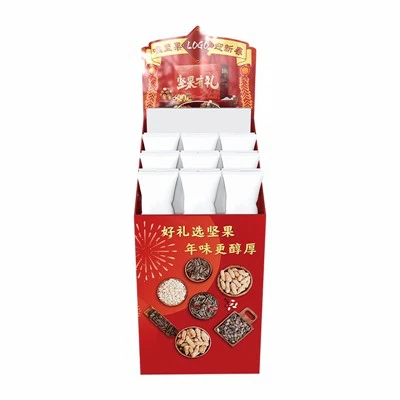
If you’re tired of dealing with flimsy displays that fold at the worst times, hit us up to chat. We can talk about your product, your store’s layout, what kind of wear and tear your displays will actually see, and put together a quote for an impact-resistant display that’ll hold up when it matters.
Cardboard Floor Display Stand References:
- Corrugated Fiberboard Technical Association. (2021). Impact Resistance of Corrugated Materials for Retail Displays.
- Packaging Digest. (2022). Reducing Retail Display Failure Through Structural Design.
- National Association of Packaging Manufacturers. (2020). ECT Ratings and Their Role in Corrugated Product Durability.
Guangzhou Guangjie Display Products Manufacturing Co., Ltd.
We’re well-known as one of the leading cardboard countertop display manufacturers in China, also support customized service. Welcome to buy bulk high quality cardboard countertop display at competitive price from our factory. If you have any enquiry about pricelist and quotation, please feel free to email us.
Address: No. 16-1 Lilv Road, Dashi Street, Panyu District, Guangzhou City, Guangdong Province
E-mail: guangjie_dp888@163.com
WebSite: https://www.gjdisplaystand.com/
